Economy Hub
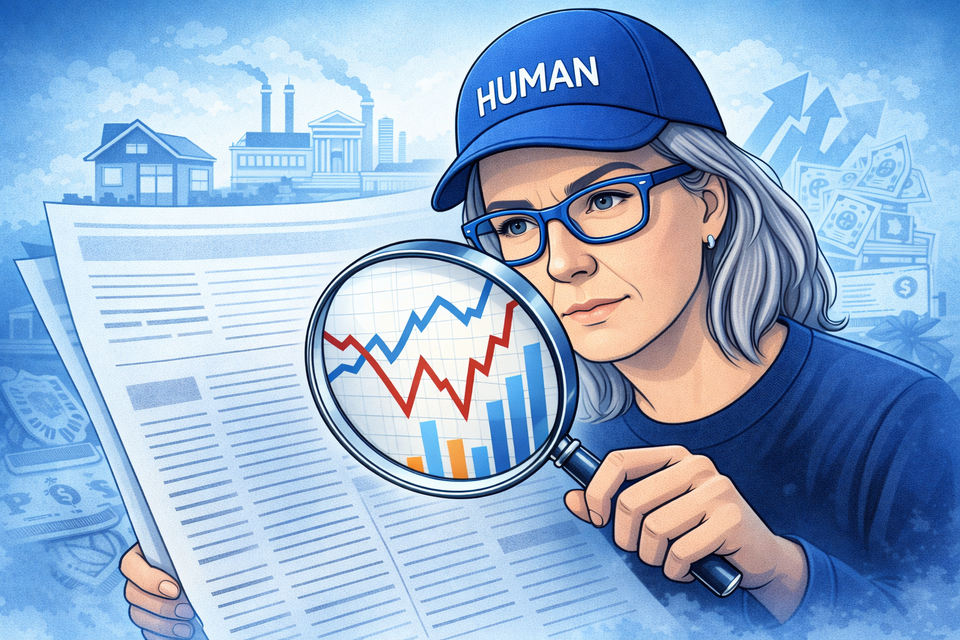
This hub provides context for understanding economic growth, inflation, labor markets, and financial conditions. Individual articles explore how macroeconomic forces shape housing, mortgages, markets, and household decisions over time.
Economy: A Quick Review
The economy is often discussed through short-term headlines — growth is accelerating, inflation is cooling, recession risks are rising. While these signals matter, they rarely explain what is actually happening beneath the surface.
At its core, the economy is the interaction between production, income, spending, credit, and expectations. These forces evolve gradually and are shaped by demographics, technology, policy decisions, and global trade—not merely by quarterly data releases.
This section explains how the economy works structurally, why cycles emerge, and why real economic outcomes often lag the narratives built around them.
The economy refers to the system through which goods and services are produced, income is generated, credit is extended, and resources are allocated across households, businesses, and governments over time.
What Drives Economic Growth
Economic growth is not simply “more spending.” It reflects the economy’s capacity to produce more output sustainably.
Key drivers of growth include:
- Labor force size and participation
- Productivity and technological advancement
- Capital investment by businesses
- Education and human capital
- Demographics and population trends
Growth can slow even when demand is present if labor is constrained, productivity stagnates, or investment declines. Conversely, growth can persist during periods of uncertainty if structural supports remain intact.
Understanding growth requires distinguishing between temporary demand surges and long-term capacity expansion.
Inflation, Deflation, and Prices
Inflation is often treated as a single number, but it reflects many underlying pressures.
Price changes are influenced by:
- Supply constraints and production costs
- Wage growth and labor availability
- Energy and commodity markets
- Monetary conditions and credit availability
- Consumer and business expectations
Inflation can ease without prices falling, and prices can rise even as demand weakens if supply remains constrained. Deflation, while less common, entails risks of its own by discouraging investment and consumption.
This section examines how inflation arises, why it can persist, and why controlling it is often slower and more complex than expected.
Labor Markets and Income
The labor market is central to economic stability. Employment, wages, and job mobility determine household security and spending power.
Important labor dynamics include:
- Job creation and destruction
- Wage growth relative to productivity
- Participation rates and workforce aging
- Skill mismatches and sector shifts
- Geographic mobility
Strong labor markets can coexist with slowing growth, just as weak labor conditions can persist after recessions officially end. Income stability — not just job counts — shapes economic confidence and housing demand.
Understanding labor markets means looking beyond unemployment rates to participation, wage quality, and long-term trends.
Economic Cycles and Recessions
Economic cycles are not accidents. They emerge from periods of expansion, excess, tightening financial conditions, and eventual adjustment.
Typical cycle phases include:
- Expansion driven by credit and investment
- Late-cycle pressures from inflation or asset imbalances
- Tightening financial conditions
- Contraction or slowdown
- Stabilization and recovery
Recessions often begin quietly and end unevenly. The effects are rarely felt equally across industries, regions, or households.
This section examines why cycles recur, why policy responses matter, and why recoveries often appear incomplete even as data improve.
Financial Conditions and Credit
Credit availability influences nearly every part of the economy. When credit is abundant and affordable, spending and investment expand. When credit tightens, activity slows — sometimes abruptly.
Financial conditions are shaped by:
- Interest rates and yield curves
- Bank lending standards
- Investor risk appetite
- Asset prices and volatility
- Regulatory oversight
Changes in financial conditions often precede changes in economic data. Understanding credit dynamics helps explain why economic momentum can shift before it shows up in employment or inflation reports.
The Human Side of the Economy
Economic outcomes are experienced by people, not averages.
Households make decisions based on income stability, job security, debt obligations, and future expectations — not GDP prints. Confidence, fear, and uncertainty influence spending and saving behavior in ways models cannot fully capture.
Two households facing the same economic environment may respond very differently, and both responses can be rational.
Understanding the economy means understanding how people adapt to constraints, uncertainty, and opportunity—not just how numbers change.
Why This Hub Exists
This publication does not attempt to forecast short-term economic outcomes.
Its purpose is to provide a durable context—so readers can better interpret headlines, understand trade-offs, and make informed decisions without reacting to noise.
The economy is complex, slow-moving, and deeply interconnected. Clear explanations matter.
If you’re considering a purchase, refinance, or simply want to understand how current mortgage conditions apply to your situation, you can schedule a one-on-one conversation with me.
There’s no obligation — just a clear, practical discussion focused on your goals and constraints.